Average adults 3.5-5 m; exceptional animals larger
CrocAttack African country rows, about 82/year. A floor: African records are largely incomplete
Erickson et al. 2012; tested animals were small (~86 kg). Large adults scale far higher
Sub-Saharan Africa; population relatively stable
Africa's Apex Aquatic Predator
Crocodylus niloticus is Africa's largest reptile and among the continent's most feared predators. Despite its name, the Nile crocodile's range extends far beyond the Nile River: it inhabits rivers, lakes, swamps, and estuaries across sub-Saharan Africa, from Senegal in the west to Ethiopia and Somalia in the east, south to South Africa. The Nile River itself, the Congo Basin, Lake Victoria, the Okavango Delta in Botswana, and the Zambezi River all hold substantial populations.
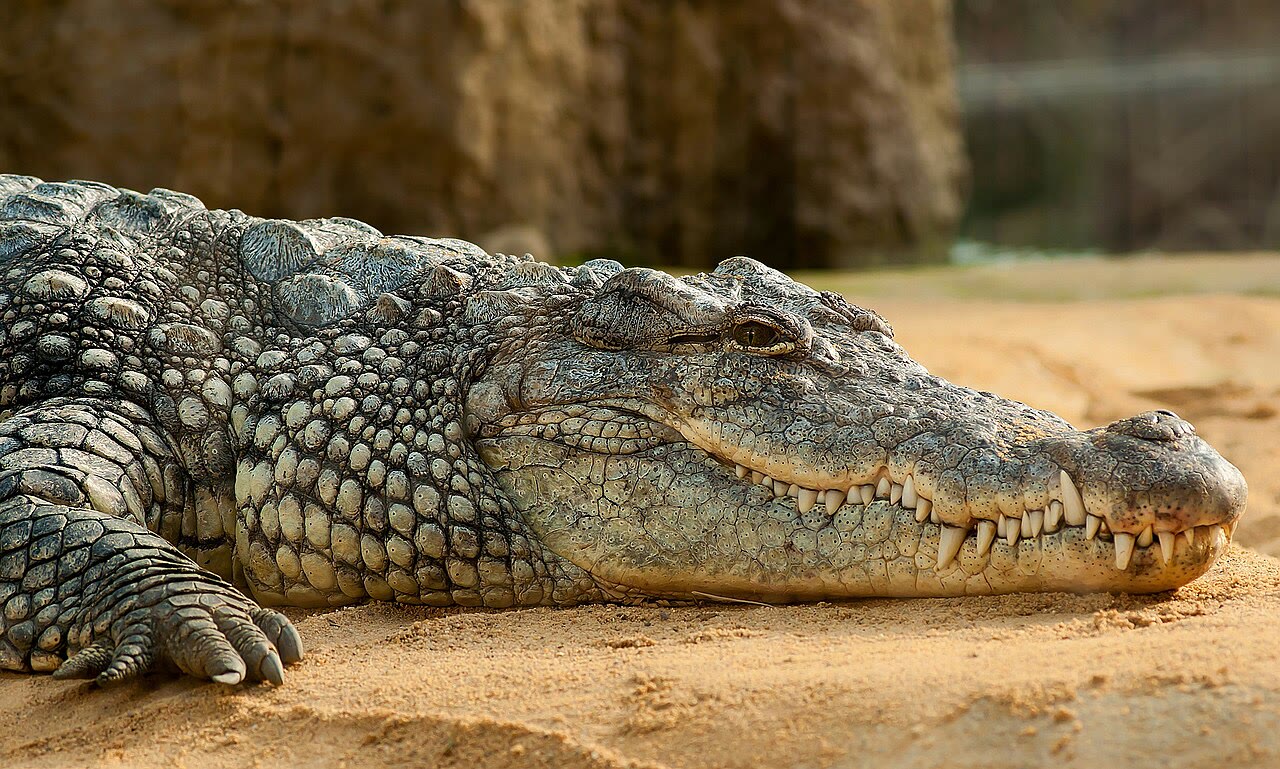
Adult males reach up to 5.5 metres and 750 kg. The species shows marked sexual dimorphism, with females substantially smaller at around 3 to 3.5 metres. Colouration is olive to brown-grey, darker in older individuals, with irregular darker banding or blotching. Like all crocodiles, the Nile crocodile has the characteristic narrow V-shaped snout and the prominent exposed fourth lower tooth when the mouth is closed.
Hunting: Ambush, Death Roll, and Cooperative Feeding
Nile crocodiles are generalist ambush predators. Fish form the bulk of the diet for smaller individuals and in normal conditions. However, Nile crocodiles are notorious for attacking large mammals at river crossings: wildebeest, zebra, cape buffalo, and hippos are all on record. At the Mara River in Kenya and Tanzania, crocodiles gather in numbers each year to ambush the wildebeest migration crossing, one of the most dramatic predation events in the natural world.
The Nile crocodile also engages in a cooperative feeding behaviour unusual among reptiles: groups have been observed corralling schools of fish and defending large carcasses collaboratively. This is not true cooperation in the mammalian sense, but it goes beyond simple opportunism.
The death roll, a rapid spinning motion used to tear flesh from large prey, is a signature behaviour. The two Nile crocodiles in the Erickson 2012 bite-force study were small animals (around 86 kg) and recorded 3,172 N, but bite force scales tightly with body mass: a 750 kg adult, the size this species reaches, bites in the same league as a large saltwater crocodile. Combined with the death roll, that generates enormous tearing force. Once a large Nile crocodile has an animal in the water, escape is extremely difficult.
Human Fatality Data
The Worldwide Crocodilian Attack Database, established at Charles Darwin University as CrocBITE and now maintained by Brandon Sideleau at crocattack.org, is the global repository for crocodilian attack data. Its published country rows for 2015 to 2024 add up to about 1,200 recorded attacks in Africa and 820 recorded deaths, an average of roughly 82 deaths a year. Zambia (116 deaths) and Zimbabwe (107) recorded the most, followed by Malawi, Tanzania and Mozambique on 71 to 73 each. The database does not publish a species total, so that figure is our addition of its country rows; every input is on the page linked above.
That count is a floor, and for this species a particularly soft one. CrocAttack states plainly that African records should be viewed as largely incomplete, that only Namibia and South Africa are believed to capture most of their incidents, and that a very high number of incidents elsewhere went unrecorded. Many attacks happen in rural areas where the victim cannot reach medical care and nothing is reported to any authority. The saltwater crocodile has more recorded deaths over the same decade, from regions the database rates as better documented, so the real ranking between the two is genuinely unsettled.
You will often see this species credited with 200 to 300 deaths a year. That figure traces to a National Geographic species page which says, in the same sentence, that firm numbers are sketchy and that up to 200 people may die each year. It is a hedged ceiling from a magazine rather than a database output, and it should not be quoted as the latter.
The disproportionate fatality rate compared to American alligators and American crocodiles reflects several factors: larger average body size of attacking animals, high proximity of rural communities to crocodile habitat (people wash clothes, fetch water, bathe, and fish at river edges), and a level of predatory boldness in Nile crocodiles that is not characteristic of American species.
Major rivers in Tanzania, Mozambique, Uganda, and the Congo are considered high-risk. The Rufiji River in Tanzania, the Zambezi, and the Limpopo are among the rivers with documented high attack rates. Tourist safari areas like the Okavango and the Mara River are managed and relatively safe for properly supervised visitors, but Nile crocodiles demand respect throughout their range.
Cultural Significance
No animal features more prominently in ancient Egyptian religious and cultural life than the crocodile. Sobek, the crocodile-headed deity, was a major god associated with the Nile, fertility, and pharaonic power. Temples dedicated to Sobek were built at Kom Ombo and Crocodilopolis (Faiyum). Sacred crocodiles were kept in temple pools and mummified on death; thousands of crocodile mummies have been excavated from Egyptian sites.
In contemporary sub-Saharan Africa, crocodiles feature in the oral traditions, spiritual practices, and taboo systems of dozens of cultures across the continent. In some communities along the Congo and Niger rivers, crocodiles are associated with ancestral spirits. In others they are hunted for meat, hide, and traditional medicine. The dual status, feared predator and culturally significant animal, makes crocodile conservation in Africa a complex socio-political challenge.