Snout Shape: U vs V
Look at the snout from directly above. Alligator snouts are broad and rounded at the tip, forming a clear U-shape. Crocodile snouts are longer, narrower, and pointed at the tip, forming a V-shape. This difference is consistent across all species in both families.
The wider alligator jaw is an adaptation for crushing hard-shelled prey like turtles, which are common in their freshwater habitat. The narrower crocodile jaw is better suited for grabbing fish and medium mammals. Saltwater crocodiles, despite being massive, still show the characteristic V-shaped taper.
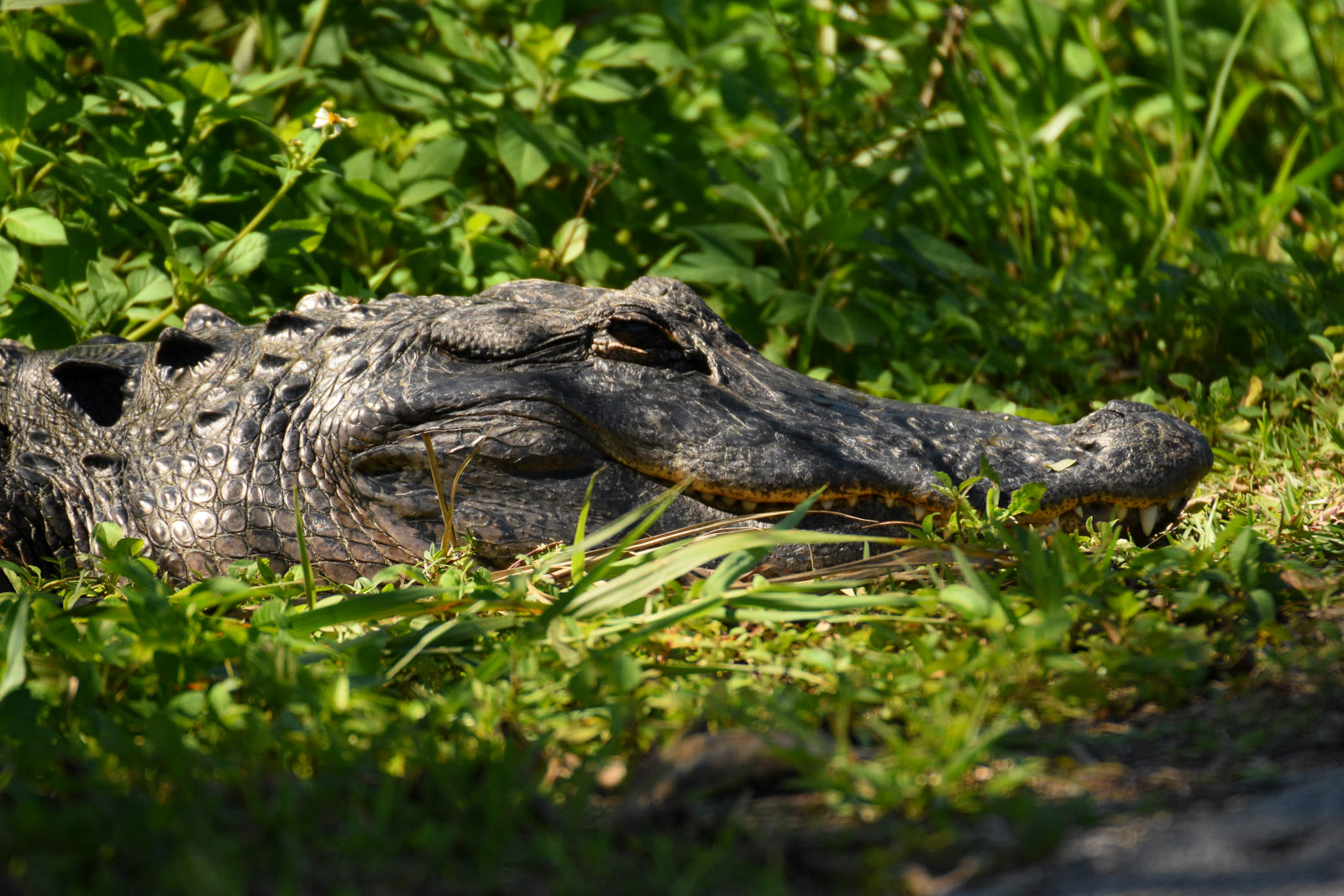
Broad, rounded snout. Wide jaw. U-shaped from above. Short rostrum relative to head width.
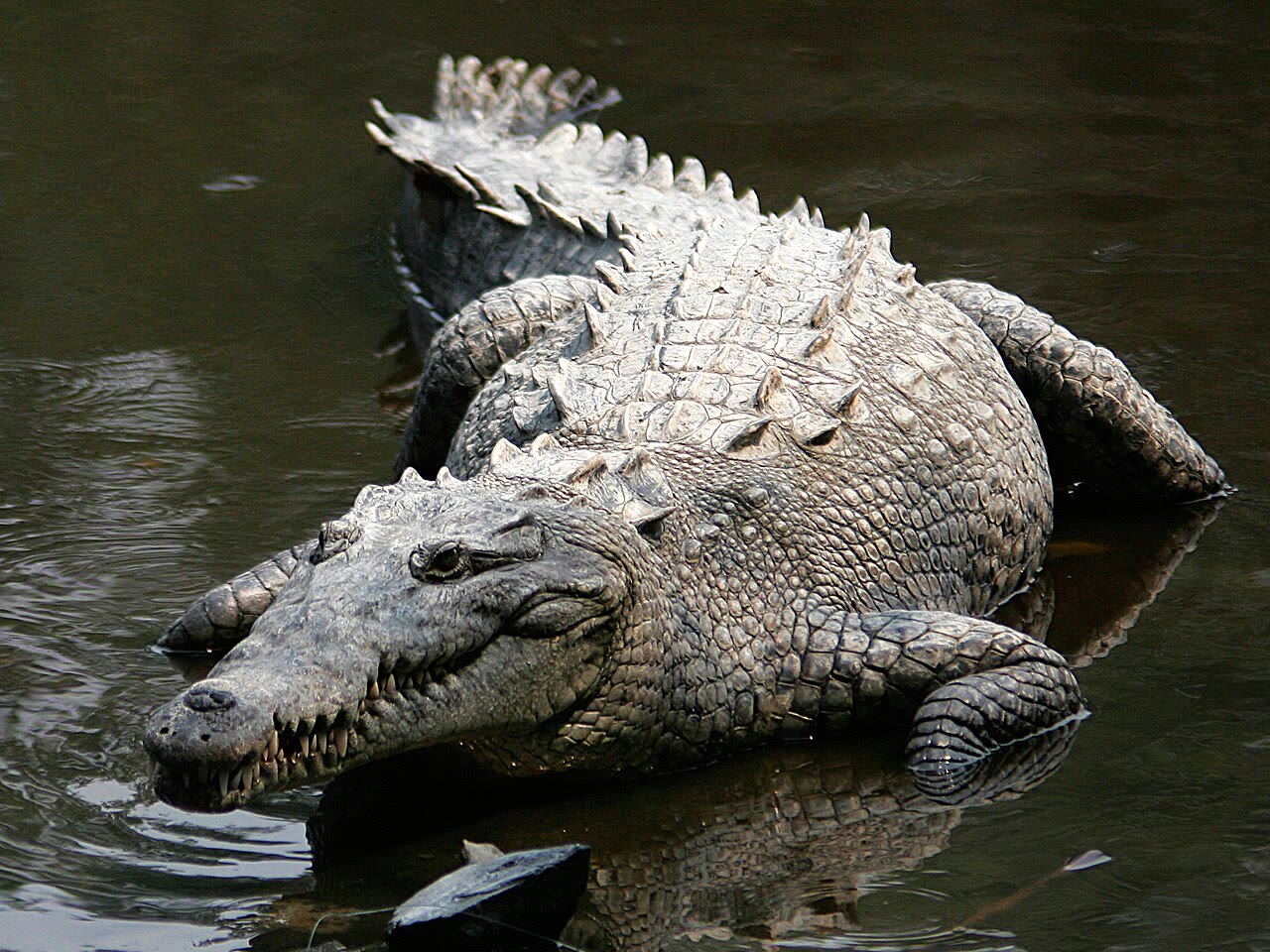
Long, narrow snout. Pointed tip. V-shaped from above. Rostrum length approximately twice the width.
Teeth Visibility When Mouth Is Closed
Alligators have a wide upper jaw that completely covers the lower jaw when the mouth is closed. Only the upper teeth are visible. The lower teeth fit into sockets inside the upper jaw and disappear from view entirely.
Crocodiles have upper and lower jaws of almost equal width. When the mouth closes, the teeth interlock rather than nest. The fourth tooth of the lower jaw on each side is especially large and remains clearly visible as a protruding fang even when the mouth is shut. This is the most dramatic visual difference at close range.
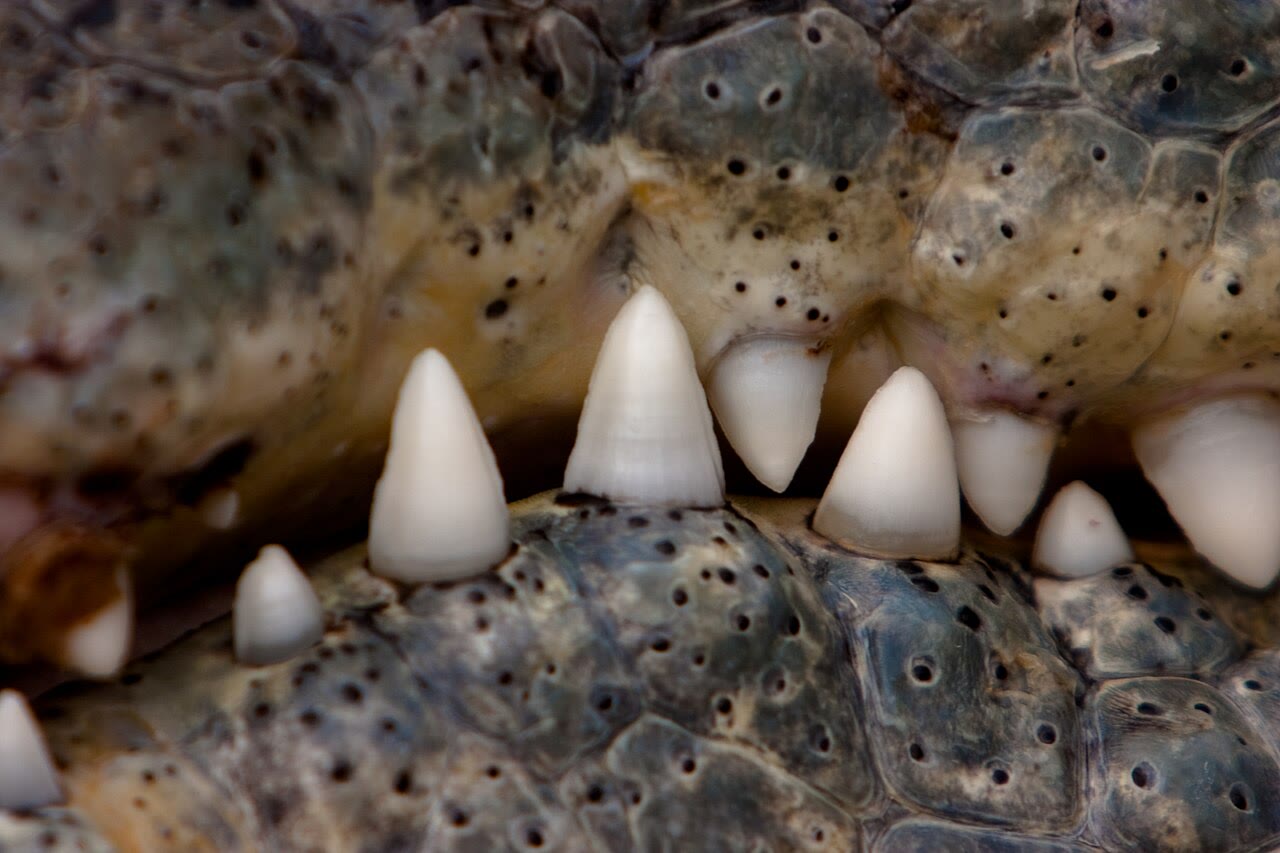
Field tip:
If you can see a large tooth protruding from the lower jaw when the animal's mouth is closed, it is almost certainly a crocodile. If the jaw line looks smooth with only upper teeth showing, it is most likely an alligator.
Skin Colour
American alligators are typically dark charcoal grey to nearly black on their dorsal (top) surface, with a pale cream or yellow underbelly. Young alligators have yellow banding that fades as they mature. The dark colouration develops partly from the tannin-stained, dark freshwater swamps they inhabit.
Crocodiles are generally lighter in colour: olive, tan, grey-green, or brownish, often with darker banding or mottling. American crocodiles are noticeably lighter grey-green than American alligators. Saltwater crocodiles are pale olive-grey. Nile crocodiles range from olive to brown-grey. The lighter tone may relate to their more varied, often sunnier habitats.
Colour is the least reliable identification test in isolation because juveniles, conditions, and individuals vary. Always use snout shape as your primary check.
Saltwater Tolerance and Lingual Salt Glands
Crocodiles have functional lingual salt glands on their tongue that actively excrete excess salt. This physiological adaptation allows them to tolerate saltwater and brackish environments for extended periods. Saltwater crocodiles are the most extreme example, routinely crossing open ocean between islands. Nile crocodiles and American crocodiles also use estuaries and coastal zones.
Alligators also have integumentary sense organs (ISOs) on their tongue and skin, the same structures, but in alligators these are not fully functional as salt glands. The result is that alligators can tolerate brackish water briefly but become physiologically stressed in sustained saltwater. They are primarily confined to freshwater: swamps, rivers, lakes, and marshes.
Practical use: if you see a large crocodilian in a coastal estuary, coastal lagoon, or open salt marsh outside southern Florida, it is almost certainly a crocodile, not an alligator.
Size at a Glance
American alligators and American crocodiles overlap substantially in size: both reach around 3.5 to 4.6 metres for large adults. Size alone will not distinguish them in Florida. However, in other parts of the world, extreme size narrows the candidates significantly.
If the animal is more than 5 metres long, it is almost certainly a saltwater crocodile (IndoPacific) or a Nile crocodile (Africa). If the animal is under 2 metres, it may be a Chinese alligator (the world's smallest alligator species, rarely exceeding 1.5 metres) or a caiman, not a crocodile.
| Species | Max length | Max weight |
|---|---|---|
| Saltwater crocodile | 6.3 m (20.7 ft) | 1,000+ kg |
| Nile crocodile | 5.5 m (18 ft) | 750 kg |
| American alligator | 4.6 m (15 ft) | 450 kg |
| American crocodile | 4.6 m (15 ft) | 400 kg |
| Spectacled caiman | 2.5 m (8.2 ft) | 58 kg |
| Chinese alligator | 1.5 m (4.9 ft) | 23 kg |
| Gharial | 6.0 m (19.7 ft) | 977 kg |
Where in the World Are You?
Geographic range is often the fastest identification shortcut before you even see the animal.
Louisiana, Mississippi, Alabama, Georgia, South Carolina, Arkansas
American alligator only. No crocodiles naturally occur this far inland or north.
Southern Florida (Everglades, Florida Bay, Biscayne Bay)
Could be either. American alligators dominate freshwater. American crocodiles prefer coastal/brackish areas. The only place on Earth where both species coexist.
Central America, Caribbean, northern South America
American crocodile, or one of several other crocodile species. No alligators outside the SE USA and China.
Sub-Saharan Africa
Nile crocodile. No alligators whatsoever in Africa.
Northern Australia, Papua New Guinea, SE Asia
Saltwater crocodile, and/or freshwater crocodile (Crocodylus johnstoni) in Australia.
India, Nepal, Bangladesh
Mugger crocodile (Crocodylus palustris), possibly gharial in rivers. No alligators.
Yangtze River basin, China
Chinese alligator, one of the world's most endangered reptiles with fewer than 300 remaining in the wild.
Aggression and Behaviour
The popular claim that crocodiles are more aggressive than alligators is a useful generalisation, but it must be framed correctly. In the wild, Nile crocodiles and saltwater crocodiles are far more prone to predatory attacks on humans than American alligators. This is partly because those species are larger, partly because they share habitat more closely with rural communities, and partly because individual species differ in threat-response behaviour.
American alligators are naturally wary of humans and will typically retreat when approached. However, alligators that have been fed by humans lose this fear rapidly and become dangerous. Florida FWC's own bite table, last updated February 2026, records 500 unprovoked bites statewide since 1948, of which 32 were fatal. The rate has risen: the ten years 2016 to 2025 account for 119 of those bites and 9 of the deaths, so about 12 unprovoked bites a year against an all-time average nearer six. FWC separately reports that roughly eight bites a year are serious enough to need professional medical treatment, and puts a Florida resident's odds of serious injury in an unprovoked incident at about one in 3.1 million.
American crocodiles in south Florida are also generally shy of humans, more so than their African and Australian relatives. They are not considered a significant public safety risk in Florida, with very few recorded attacks.
Saltwater crocodiles are the exception at the extreme: they are apex predators that actively treat large mammals, including humans, as potential prey. They should be treated with extreme caution throughout their range.